
IDEADS Inc.



Greg Marinovich &
Kevin Carter


THE PASSION OF A PHOTOGRAPHER,
FILMMAKER AND AUTHOR
Greg Marinovich, born in South Africa in 1962, is a Pulitzer Prize-winning photographer and is co-author of The Bang Bang Club, a non-fiction book on South Africa’s transition to democracy.
He has spent 18 years doing conflict, documentary and news photography around the globe. His photographs have appeared in top international publications such as Time, Newsweek, The New York Times, The Washington Post, Wall Street Journal, The Guardian of London, among others. He is chair of the World Press master Class nominating committee for Africa, and was a World Press Photo judge in 1994, as well as convener of the FujiFilm awards in 2000.
2010 - Editor-in-Chief of the World Press Photo and Lokaalmundial’s 2010 project, mentoring and training journalists, writers, photographers, radio journalists and multi-media practitioners from across Africa. Amazing project
April 1996 – Aug 1997: Chief Photographer, The Associated Press, Israel/Palestine.
1993 – 1996: Freelance photographer, Time, Newsweek, The New York Times, the Associated Press. Worked in Angola, Bosnia, Chechnya, India, Mozambique, Russia, Rwanda, South Africa, Zaire.
1990 – 1992: Freelance photographer with the Associated Press, Sygma, The European, South African publications. Editor-at-Large and columnist at Living Africa, a general interest and lifestyles magazine. Worked in Angola, Bosnia, Croatia, Somalia, South Africa, Yugoslavia.
During apartheid, South Africa’s white minority government made its goal to encourage Inkatha-ANC divisions to keep its black enemies at each others’ throats. Now, in 1990, as the government of F.W. de Klerk began negotiating with Nelson Mandela’s ANC, these divisions presented a golden opportunity for some. Using the Zulu Inkatha Freedom Party (IFP) as their proxy, some elements within the establishment tried to destabilize the country, scuttle the negotiations, and at least delay the majority rule.
Thousands of Zulus were forced out of their homes in ANC-loyal areas in Natal. The Zulus fought back violently, as police were reluctant to restore order. From July to September 1990, in one of the bloodiest clashes in modern South African history, the Zulus launched raids in the Transvaal townships, where nearly 800 were slain. In 1990 alone, over 3,000 people died as violence escalated.
A mob murder at Soweto’s Nancetield Hostel put a previously broke freelancer with obsolete cameras named Greg Marinovich on the road to international recognition. Marinovich felt as if he was “one of the circle of killers, shooting with wide-angle lens”. For the photo of a man hacking at a burning man with a machete, Marinovich would later win a Pulitzer in 1991 . A Zulu named Lindsaye Tshabalala was suspected of spying for Inkatha, and was executed by African National Congress supporters. Marinovich remembers:
“This was without doubt the worst day of my life, and the trauma remains with me,
despite some twenty years and a lot of coming to terms with the incident, my role
and what it means to be involved in murder. This mudered happened a month after
I had witnessed the one in Nancefield Hostel, and I was determined to redeem myself
by not just being an observer. I neither saved him, nor redeemed myself, though at
least I did not act shamefully.”
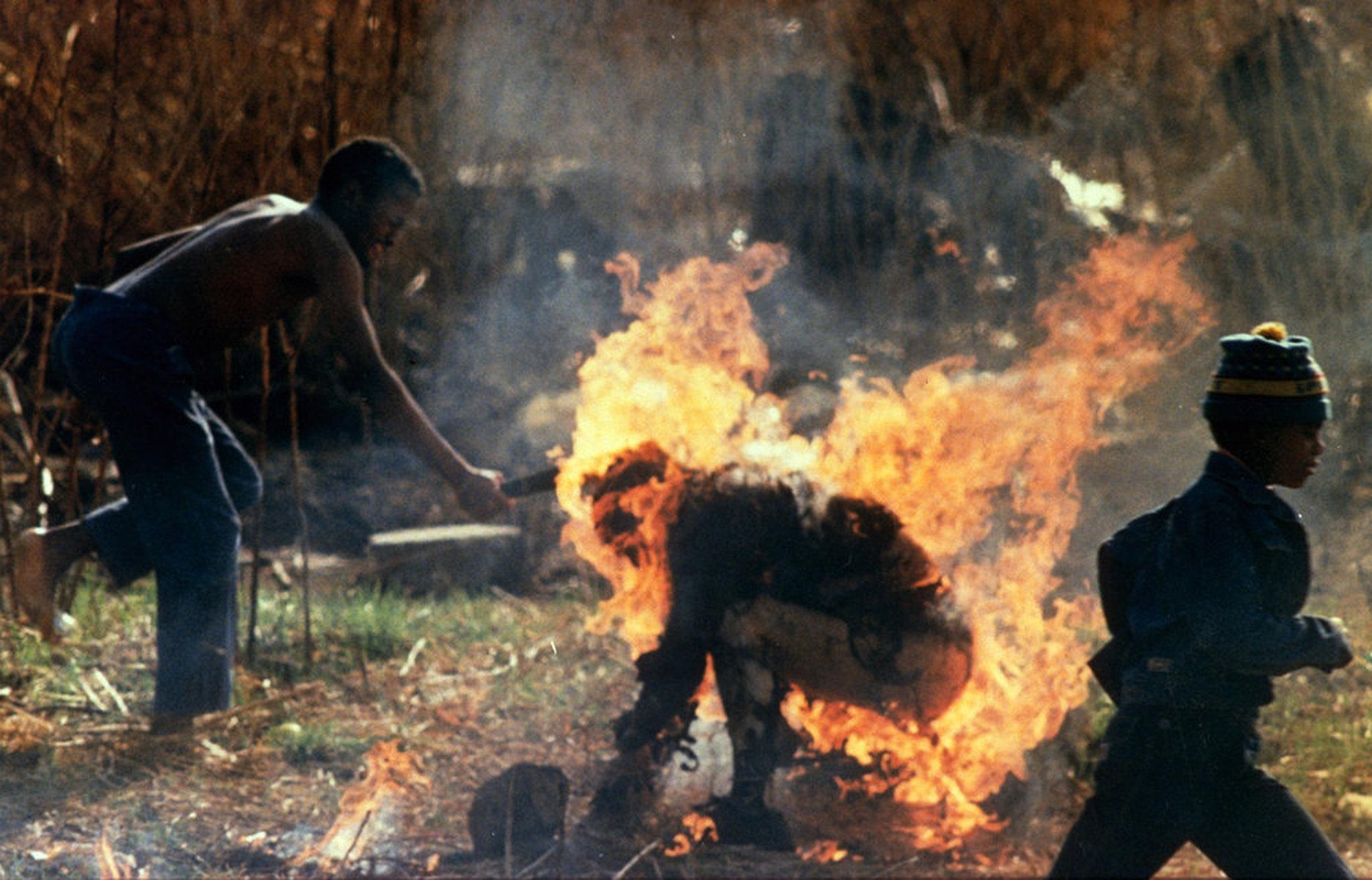
Marinovich's Pulitzer Prize-winning photograph


Kevin Carter was born in Johannesburg, South Africa. Carter grew up in a middle-class, whites-only neighborhood. As a child, he occasionally saw police raids to arrest blacks who were illegally living in the area. He said later that he questioned how his parents, a Catholic, "liberal" family, could be what he described as 'lackadaisical' about fighting against apartheid.
After high school, Carter dropped out of his studies to become a pharmacist and was drafted into the army. To escape from the infantry, he enlisted in the Air Force in which he served four years. In 1980, he witnessed a black mess-hall waiter being insulted. Carter defended the man, resulting in him being badly beaten by the other servicemen. He then went AWOL, attempting to start a new life as a radio disk-jockey named "David". Soon after, he decided to serve out the rest of his required military service. After witnessing the Church Street bombing in Pretoria in 1983, he decided to become a news photographer.
Carter had started to work as a weekend sports photographer in 1983. In 1984, he moved on to work for the Johannesburg Star, bent on exposing the brutality of apartheid. Carter was the first to photograph a public execution "necklacing" by black Africans in South Africa in the mid-1980s. Carter later spoke of the images: "I was appalled at what they were doing. But then people started talking about those pictures... then I felt that maybe my actions hadn't been at allll bad. Being a witness to something this horrible wasn't necessarily such a bad thing to do."[3]
In March 1993, while on a trip to Sudan, Carter was preparing to photograph a starving toddler trying to reach a feeding center when a hooded vulture landed nearby. Carter reported taking the picture, because it was his "job title", and leaving. He was told not to touch the children for fear of transmitting disease.
Sold to the New York Times, the photograph first appeared on 26 March 1993 and was carried in many other newspapers around the world. Hundreds of people contacted the newspaper to ask the fate of the girl. The paper reported that it was unknown whether she had managed to reach the feeding centre. In April 1994, the photograph won the Pulitzer Prize for Feature Photography. He committed suicide 3 months after winning.
On 27 July 1994 Carter drove his way to Parkmore near the Field and Study Center, an area where he used to play at as a child, and committed suicide by taping one end of a hose to his pickup truck’s exhaust pipe and running the other end to the driver's side window. He died of carbon monoxide poisoning at just 33. Portions of Carter's suicide note read:
"I'm really, really sorry. The pain of life overrides the joy to the point that joy does not exist...
depressed ... without phone ... money for rent ... money for child support ... money for debts ...
money!!! ... I am haunted by the vivid memories of killings and corpses and anger and pain ...
of starving or wounded children, of trigger-happy madmen, often police, of killer executioners ...
I have gone to join Ken if I am that lucky."
